MSP in the Netherlands

MSP in the Netherlands

Is MSP conquering the Netherlands? We are indeed seeing Staffing MS’s Managed Service Provider service add clear value to more and more employers. But what does MSP in the Netherlands actually entail?

The Managed Service Provider relieves the burden

A Managed Service Provider takes care of external hiring on behalf of companies and organisations. An MSP acts as an extension of the HR team and purchasers, takes processes off their hands and optimises wherever possible. It is a service that goes beyond that of the usual contract management parties and intermediaries.

Of course, the MSP also provides complete administrative contract management, including on- and off-boarding, digital file creation, invoicing and reporting. And just like the intermediaries, it performs candidate search and matching. But above all, the MSP is the party that runs through business planning with HR teams and purchasers and plans external hiring requirements for the long- and short-term. A large proportion of their responsibilities are taken off their hands, and a well-functioning recruitment plan is created and implemented. That includes creation of the requests. The MSP professionals thus represent a fully-fledged discussion partner who ‘know’ the business and have a direct line to the client’s HR and purchasing teams.

Because the provider serves multiple clients, oversees a comprehensive network of suppliers and is equipped with advanced Vendor Management System solutions, an MSP can often not only relieve Dutch companies of some of the burden, but also achieve some serious cost savings within the complex hiring chain.

Key driver for MSP in the Netherlands: labour shortage

The corporate and (semi)government worlds fish in one and the same pond, of course. And despite tentative predictions that the market is beyond boiling point, we still find ourselves in strong competition for roles at MBO+, HBO and WO-education level in particular. In a ‘seller’s market’ like this, whereby the employees are the sellers, it is of course very important that the hiring is conducted by a party that knows the market. A party that can do more than external hiring alone and can take care of contract management. A partner with whom organisations can discuss their business operations on both the tactical and strategic level, planning their hiring needs jointly. For more and more businesses in the Netherlands, the use of an MSP to take care of the full hiring process and tackle scarcity in the market is proving the go-to solution.

Greater need for MSP in the Netherlands due to complex legislation and regulations

The fundamental debate taking place on the balance between temporary and permanent work in the Netherlands will have escaped nobody’s attention. Many employers are enthusiastic about the contingent workforce, which keeps fluctuations in the volume and type of employees manageable. At the same time, the politicians are concerned with the legal position of less highly educated employees in particular, who are also increasingly being forced into such flex-structures.

In concrete terms, policy makers have responded with new laws such as the wet DBA (deregulering beoordeling arbeidsrelatie) and the Wet arbeidsmarkt in balans (WAB). This legislation is intended to create clarity, yet does not always succeed, to put it mildly. This is another reason why companies and organisations are seeking out a business partner: someone who not only ‘processes requests’ but is also capable of proactively addressing changes in legislation and regulations and of shielding clients from the potholes.

Keen to familiarise yourself with the service package of a Managed Service Provider?

Want to know more about how an MSP goes about this in the Netherlands? Talk to the experts; a party with a long track record in delivering MSP services to companies and (government) organisations. At Staffing MS, we perform the role of MSP to our clients on a daily basis. We keep a handle on and administer their total end-to-end hiring process. We maintain a huge network of suppliers and freelancers, which generates better quality candidates, faster. Our streamlined MSP-chain provides an efficient, cost-saving (10-20%!) and seamless administrative process you no longer need worry about. What’s more, we make sure that we always do this in accordance with the laws and regulations applicable at the time – even if they change from one day to the next.

Want to know more about our Staffing MS approach? Get in touch. We’d be happy to talk you through it. Please contact us.
Staffing MS launches optimised Hiring Desk

Staffing MS launches optimised Hiring Desk

Managed Service Provider (MSP) Staffing MS – part of HeadFirst Group – is known among other things as a specialist Hiring Desk provider. Over 50 organisations are already making use of the hiring desk in the form of a Dynamic Purchasing System (DPS) and / or marketplace, supported by Staffing MS. Each and every one of these businesses will soon benefit from an optimised portal. First in line are Inhuurdesk Groene Hart en Inhuurdesk Alphen aan de Rijn. Wouter Waaijenberg, Managing Director at Staffing MS, explains the advancements made.

A hiring desk for public and private

1st July 2016 saw the revised Public Procurement Act (aanbestedingswet) come into effect. It meant that organisations with a public procurement obligation needed to re-think their hiring strategy. Many of them moved over from a hiring marketplace to a DPS. “With a number of ‘lawful’ amendments, it was possible for the popular marketplaces to become appropriate for use with a DPS, so that (semi-)government organisations would also be able to hire external professionals in line with the European rules on public procurement. The DAS is a lawful support tool that is available as part of the Recruitment Desk. All with a common goal: to advertise assignments and facilitate contract management.

The Hiring Desk is also deployed by the MSP in the private sector, particularly for ‘open market’ strategy, whereby independent professionals and suppliers of professionals can register with the client’s Hiring Desk free of charge to be able to respond to open assignments.

Developments

The first thing you notice about the Hiring Desk is the new style. Waaijenberg: “During its development, a lot of attention was given to user-friendliness for professionals and suppliers wanting to be informed about hiring assignments. The style is contemporary and fresh, yet the open assignments are clearly listed on the homepage.”

The second update concerns a direct link with Nétive VMS, which makes it possible to automatically post requests on the Hiring Desk, based on their status. Awards are also posted instantly on the back of assignments created for a request. “Previously, our consultants had to input requests in two places in order to publish them externally on the Hiring Desk. This is no longer necessary, meaning that the throughput speed for a request is even shorter. Considering the number of requests we process on a daily basis, this is a huge optimisation for both consultant and client”, comments Waaijenberg.

Lastly, the portals received the latest security updates and were brought up to speed with current technology standards. A well-maintained website is not only more user-friendly for the visitor, but is also safer. Plus, Google places well-maintained websites higher up in the search results. “Significantly advantageous for drawing client requests to the attention of specialist professionals”, concludes Waaijenberg.

HR and recruitment professionals in the healthcare sector forced to face the facts and figures

HR and recruitment professionals in the healthcare sector forced to face the facts and figures

The high turnout at the seminar ‘Healthcare Sector Labour Market Strategy 2020’ on 12th November 2019, indicated that labour market strategy is high on the agenda for many a healthcare organisation. A couple of months ago, the organisers, Staffing MS (part of HeadFirst Group), Compagnon and Intrakoop put their heads together on how to support healthcare organisations with their market strategy. The seminar at Stadskasteel Oudaen in Utrecht was the result, providing a platform for various industry experts to share concrete guidelines on how to create a policy based on facts and data, and to make optimal use of the resources available.

Bitter PNIL

Membership organisation, Intrakoop kicked off the afternoon with the greatest challenges facing HR. According to Procurement and Product Manager, Simone Nicolaes, top of the agenda is PNIL (non-employees). Intrakoop analysed the annual reports of all its members and concluded that the average PNIL costs rose by 2.7 per cent between 2014 and 2018. These costs now sit at 5-10 per cent; a level considered undesirable by all sectors – hospitals (ZKH), mental healthcare (GGZ), handicapped care (GHZ) and nursing, care and home care (VVT). Nevertheless, Nicolaes expects the costs only to increase, among others as a result of the introduction of the WAB act (Balanced Labour Market Act) as of 1st January 2020. In addition, she warns that the proliferation in PNIL suppliers and lack of insight in collaborations and spending scope is causing issues.

“It isn’t just about acknowledging there’s a problem; what matters is using data to find solutions.”
– Geert-Jan Waasdorp (Director at Intelligence Group)

Know your audience

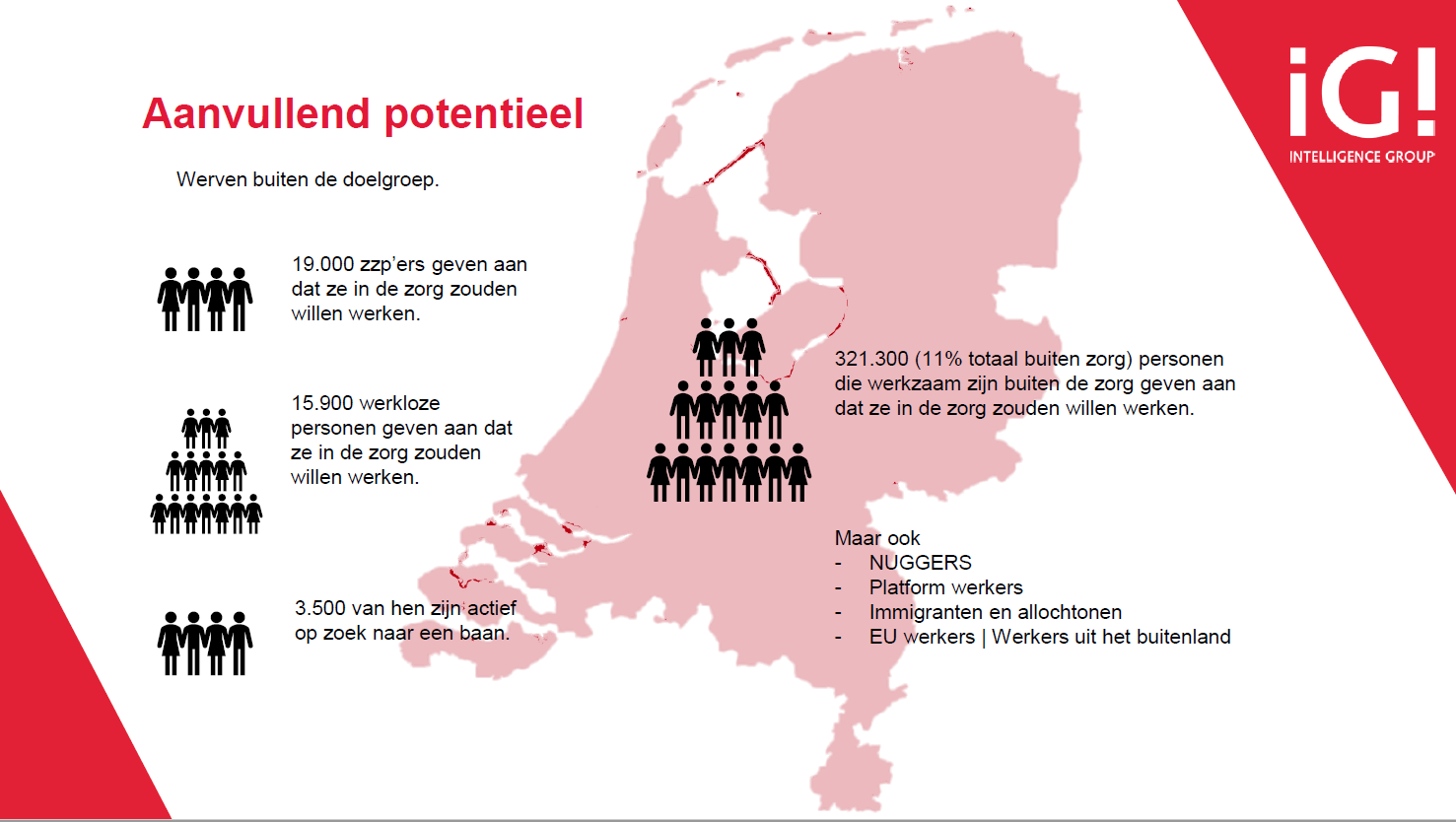
“Those who know their audience: win the heart of the labour market, can advise hiring managers properly, do not get surprised and can surprise, and never have recruitment problems”, began second speaker, Geert-Jan Waasdorp (Director at Intelligence Group). But how can you get to know your target group? The answer, he says, lies in the data, as summarised in the research report ‘Healthcare Labour Market in Numbers’. Compagnon’s annual research publication, conducted by Intelligence Group, was shared for the first time during the seminar. In the report, Waasdorp shows the reality of the healthcare labour market.
It surprises Waasdorp that the healthcare sector is perceived to be taking a financial blow when it comes to recruiting healthcare professionals. How can that be, when it is also the largest sector providing work? He also believes that some interesting target groups are being overlooked. For example, people with a migration background or inflow from education. Not forgetting the self-employed, of course. Once you know their motivation and the proposition factors they value, you have a wealth of information at your disposal that will enable you to mobilise this target group in a much more specific way.

Arbeidsmarktstrategie zorgsector 2020

But what exactly do healthcare professionals want? And what don’t they want? A brief summary:

  • Healthcare professionals expect on average 2 interviews and an application process that lasts on average 22 workdays.
  • In terms of the interview, they like to be equal parties to the employer in the conversation, and nothing pleases them more than getting to meet their future teammates / colleagues.
  • Being able to cycle to work is a huge bonus.
  • Most healthcare professionals prefer an average working week of between 24 and 29 hours.
  • They attach greater importance to a permanent contract than does the rest of the Dutch working population, rating it higher than a good salary, even.
  • The most used apps among healthcare professionals are WhatsApp, Facebook, Instagram, Nu.nl and weather app, Buienradar (after all, they want to be able to bike to work).
  • Typical apps among this target group are: Scoupy, Candy Crush, Pinterest, Wordfeud and Marktplaats
  • Nursing, V&VN Magazine, Farmacotherapeutisch Kompas, Nurse Academy and NVDA are the top five most-read trade journals.

And Waasdorp has much more to share. He has enough data to really understand the Healthcare Labour Market. Attendees at the ‘Healthcare Sector Labour Market Strategy 2020’ seminar received a copy of the research report. Interested in the findings? Download the second edition of the annual report here.

“€5,000 on a secondment agency is ‘nothing’. Yet the same amount spent on training is considered problematic”
– Geert-Jan Waasdorp (Director at Intelligence Group)

Close to home

With over 40 years’ experience in HR and healthcare, Pauline Roest (HR Manager at LangeLand Ziekenhuis) is perfectly placed to talk about recruitment in practice. A candid story in which she stresses how recruitment at LangeLand has evolved for the better over the years, but still has a long way to go. Joining the Reinier Haga Group has benefited the hospital in many ways, but also brings with it its own struggles. Such as the lack of a CAO (collective labour agreement) and agreements to which they must keep as part of the group.

“In 2017, it was all hands on deck to recruit 40 staff for the orthopaedics department. It was fab to see how we were able to make it happen, together. Now that the labour market is getting more crowded, it is important that basic recruitment becomes the ‘front door’ of a magnet-hospital”, explains Roest. Through initiatives like Volg je Hart, speed dating sessions and a Work for Us website shortly due to be launched, the LangeLand Hospital has successfully filled no less than 230 vacancies in the past two years!

Master the basics: sounds easier than it is

The second practical example was illustrated by Marianne Tulp (former Head of HR & Organisational Development at Frankelandgroep). In her view, the way in which an organisation operates has a huge bearing on the wellbeing, vitality and work satisfaction of the employee. “That’s why you need to be a vital and attractive organisation, first and foremost. Because only then are you an attractive employer to work for and stay working for”, shares Tulp.

“If the basics are in place, programmes around sustainable employment and reducing sick leave will be more effective.”
– Marianne Tulp (former Head of HR & Organisational Development at Frankelandgroep)

She continues: “At a vital organisation, everything comes together: good leadership, a meticulous HR policy, enough people to be able to do the job properly, a good atmosphere, attention and appreciation, training possibilities and opportunities for growth.” Tulp takes participants through the choices available to organisations, particularly those she herself has made consciously throughout her career. “Many of the measures I’ve mentioned require research, analysis and policy decisions. This isn’t something that happens overnight. But what matters is to remain appealing as an organisation so that you retain your staff.” Tulp concludes with several things that organisations can start with tomorrow and that, better still, are free:

  • Show your staff attention and appreciation./li>
  • Have Board / Management join work meetings.
  • Listen to what staff have to say and what is important to them.
  • Ask staff directly, what could be done differently or better.
  • Be a nice colleague yourself; it makes work more fun..
  • There is a lot of knowledge in-house – use it.
  • … celebrate successes together!

“Try to see the job as ‘ordering a job’. Does it become easier or harder?”
– Frank Roders (Director at Compagnon)

Best practise recruitment

“Sometimes things can be very simple. But the main thing is that they’re done properly”, claims Frank Roders (Director at Compagnon). He believes that there are eight areas to get straight as a HR or recruitment professional. “Start at the beginning and keep taking little steps forward. Not only do you need a good recruiter, you also need them to use a solid process.” Together with Paul Oldenburg (Business Development at Staffing MS), Roders gives a synopsis of the afternoon. According to Oldenburg, the healthcare sector sees its 5-10% external hiring as high, when actually, compared to other sectors, this number is low. The average sits at around 20%. “There are still only very few organisations that list permanent and temporary posts together on a ‘Work for Us’ website. Whilst you should really see flex as a source for permanent.”

Arbeidsmarktstrategie zorgsector 2020 figuur 2

Optimised Recruitment Desk for Atos live

Following the November 2019 announcement that Staffing MS – part of HeadFirst Group – would be optimising the Recruitment Desk of over 50 organisations, the Atos Recruitment Desk has duly been updated. Read hier the commentary from Wouter Waaijenberg, Managing Director at Staffing MS, about all the advancements made.
The hiring Desk offers Independent Professionals and Suppliers of professionals the possibility to register for free using their chamber of commerce (KvK) number, and subsequently respond to open Atos assignments. Other benefits include:

  • automatically receiving all new Atos requests via email;
  • applications can be submitted online and will be responded to within a couple of days;
  • transparent selection process;
  • contract management, time tracking and billing are all completed online.

Atos Inhuurdesk

For more information of the Atos Recruitment Desk, get in touch with one of our consultants at atos-benelux@staffingms.com or on +31 (0)10 – 760 09 05.